Refractive Surgery in Korea — Matching the Procedure to the Eye
Refractive surgery covers every operation that changes how the eye focuses — on the cornea, with an added lens, or by replacing the natural lens. Here is how ophthalmologists decide between them, based on age, prescription and anatomy.
- Corneal, phakic-lens and lens-replacement options
- One 2–3 h exam covers all options
- Prices published for every procedure
What is refractive surgery and what types are there?
Refractive surgery changes the eye's focusing power to reduce dependence on glasses. There are three families: corneal laser surgery (LASIK, LASEK/PRK, SMILE Pro), phakic lens implantation (EVO ICL) that adds a lens while keeping your own, and refractive lens exchange for presbyopia or cataract. At BGSS, prices start from ₩1.9M for both eyes (LASIK), exam included.
- Corneal laser
- LASIK · LASEK · SMILE Pro
- Phakic lens
- EVO ICL / V-Toric
- Lens replacement
- Multifocal / EDOF IOLs
- From
- ₩1.9M (both eyes)
Where in the eye each procedure works
The site of correction determines the strengths and limits of each approach.
| Family | Where it acts | Procedures | BGSS price |
|---|---|---|---|
| Corneal laser | Reshapes the corneal stroma | LASIK, LASEK/PRK, SMILE Pro | ₩1.9M–₩4.0M both eyes |
| Phakic lens | Adds a lens behind the iris; nothing removed | EVO ICL, V-Toric ICL | ₩5.2M–₩7.0M both eyes |
| Lens replacement | Replaces the natural crystalline lens | Monofocal, EDOF, trifocal (e.g. Clareon PanOptix Pro) | ₩1.5M–₩7.25M per eye |
Prices include exam, surgery and standard medications; USD approximate on treatments.
How your surgeon narrows the options
A simplified version of the clinical reasoning.
Age and lens health
From the mid-40s, presbyopia and lens changes make lens replacement relevant; younger eyes usually keep their natural lens.
Prescription size
Low–moderate myopia suits laser; very high myopia often exceeds safe tissue removal, pointing to ICL.
Corneal anatomy
Thickness, regularity and biomechanics decide whether laser is safe and which laser method fits.
Chamber and lifestyle
Anterior-chamber depth determines ICL eligibility; dry eye, sport and occupation fine-tune the choice.
Your treatment plan and price within 24 hours
- 1 Send a photo of your glasses or prescription
- 2 Get a likely procedure and estimated cost
- 3 Reserve an exam slot for your trip
No obligation · English · 中文 · 日本語 · Tiếng Việt · Монгол · Bahasa Indonesia
Why a full-range clinic matters
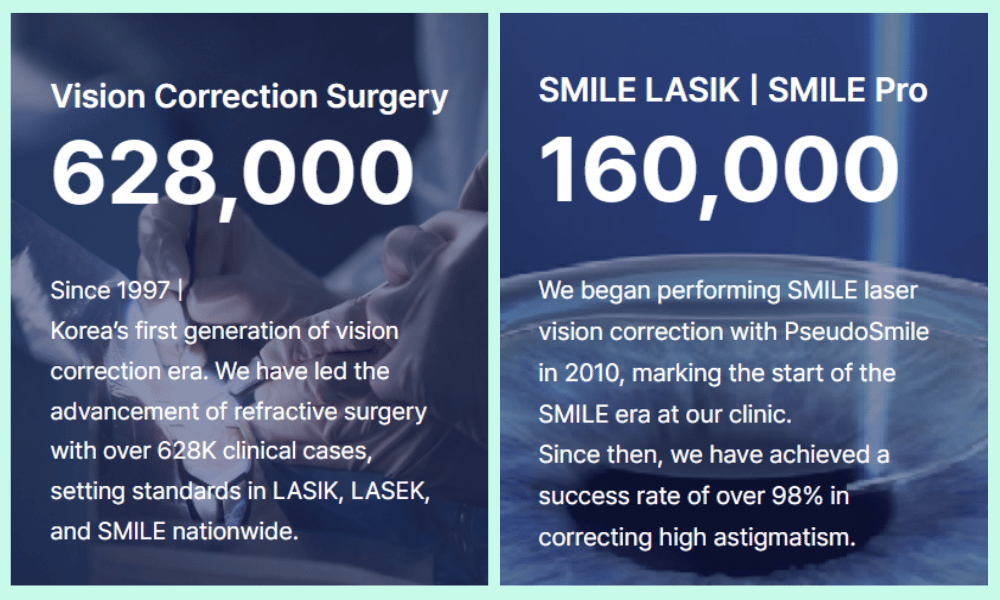
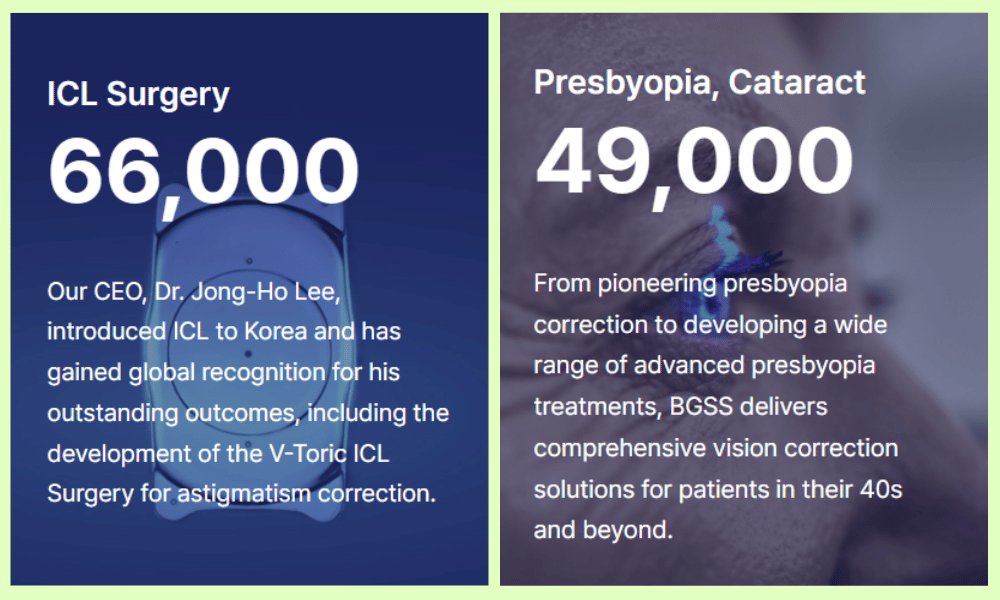
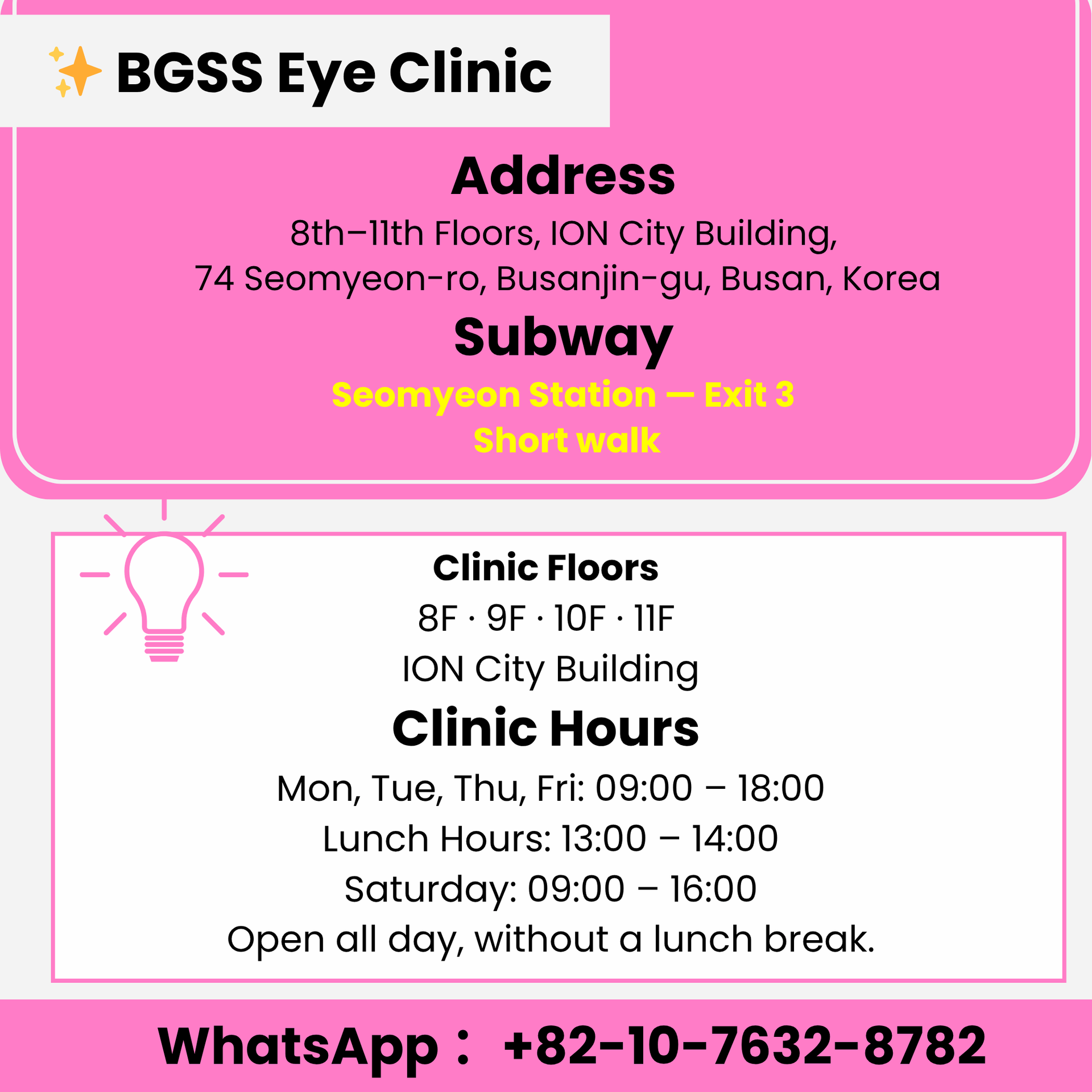
A clinic that offers only one procedure may be inclined to fit every patient to it. BGSS performs all three families of refractive surgery, with cumulative totals of 160,000+ SMILE/SMILE Pro, 66,000+ ICL and 49,000+ presbyopia and cataract procedures across Seoul and Busan.
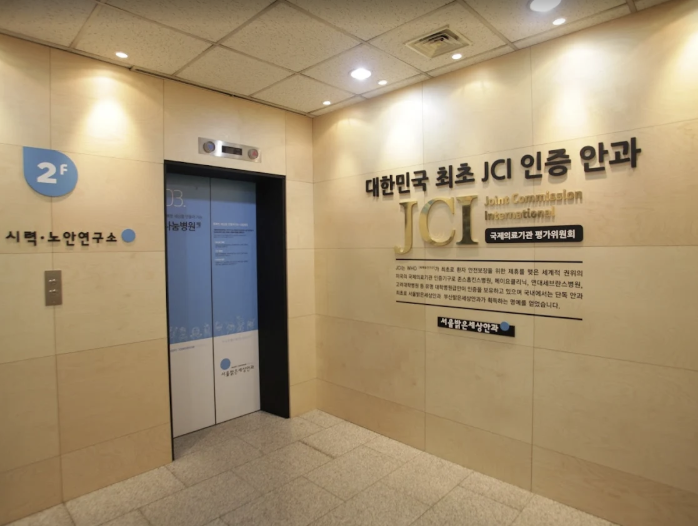
Founder Dr. Jong-Ho Lee pioneered first-generation LASIK, LASEK and ICL in Korea, and the clinic was Korea's first JCI-accredited eye clinic .
- 12 ophthalmologists
- One exam, all options considered
- Published price for every procedure
- Remote follow-up for international patients
BGSS Eye Clinic 2026 prices
Every package includes the pre-operative exam, the surgery and standard post-op medications.
| Procedure | Price (KRW) | Approx. USD | Recovery |
|---|---|---|---|
| LASIK (both eyes) | ₩1,900,000 – ₩2,400,000 | $1,340 – $1,690 | 1 day |
| LASEK / PRK (both eyes) | ₩2,200,000 – ₩2,800,000 | $1,550 – $1,980 | 3–5 days |
| SMILE / SMILE Pro (both eyes) | ₩2,500,000 – ₩4,000,000 | $1,760 – $2,830 | 1–2 days |
| EVO ICL (both eyes) | ₩5,200,000 – ₩7,000,000 | $3,670 – $4,950 | 1 day |
| Cataract / presbyopia lens (per eye) | ₩1,500,000 – ₩7,250,000 | $1,060 – $5,120 | 1–2 days |
USD values are approximate and vary with exchange rates. Final pricing is confirmed after your pre-operative exam.
- Full pre-operative diagnostic exam (2–3 hours)
- Surgery performed by a board-certified ophthalmologist
- Standard post-op eye drops and check-ups before you fly
- Medical interpreter and English medical records
Which procedure fits your eyes?
Answer 3 quick questions to see the procedure most often suited to people like you, with the 2026 starting price. Then send it to a coordinator for a free personal review.
- FREE No obligation, no deposit to ask
- 24h Reply from our international team
- MD Final plan confirmed by an ophthalmologist after your exam
How old are you?
Written and reviewed by the surgeons who perform it
Every figure on this page is a published BGSS total or a public credential you can check.
- 160,000+ SMILE / SMILE Pro
- 66,000+ ICL lens implants
- 49,000+ presbyopia & cataract
- Many with M.D., Ph.D. research backgrounds
- Founder Dr. Jong-Ho Lee: 56,000+ ICL eyes
- Complex-case and toric ICL positioning
- STAAR Surgical EVO ICL APAC Experts Summit (2024)
- Korea SMILE Forum (2025)
- Korea EVO ICL Forum (2025)
- Among Korea's first to introduce LASIK & LASEK
- Ministry of Health & Welfare–designated regenerative medicine institution
- 2026 prices published openly
- Medical content reviewed by an ophthalmologist
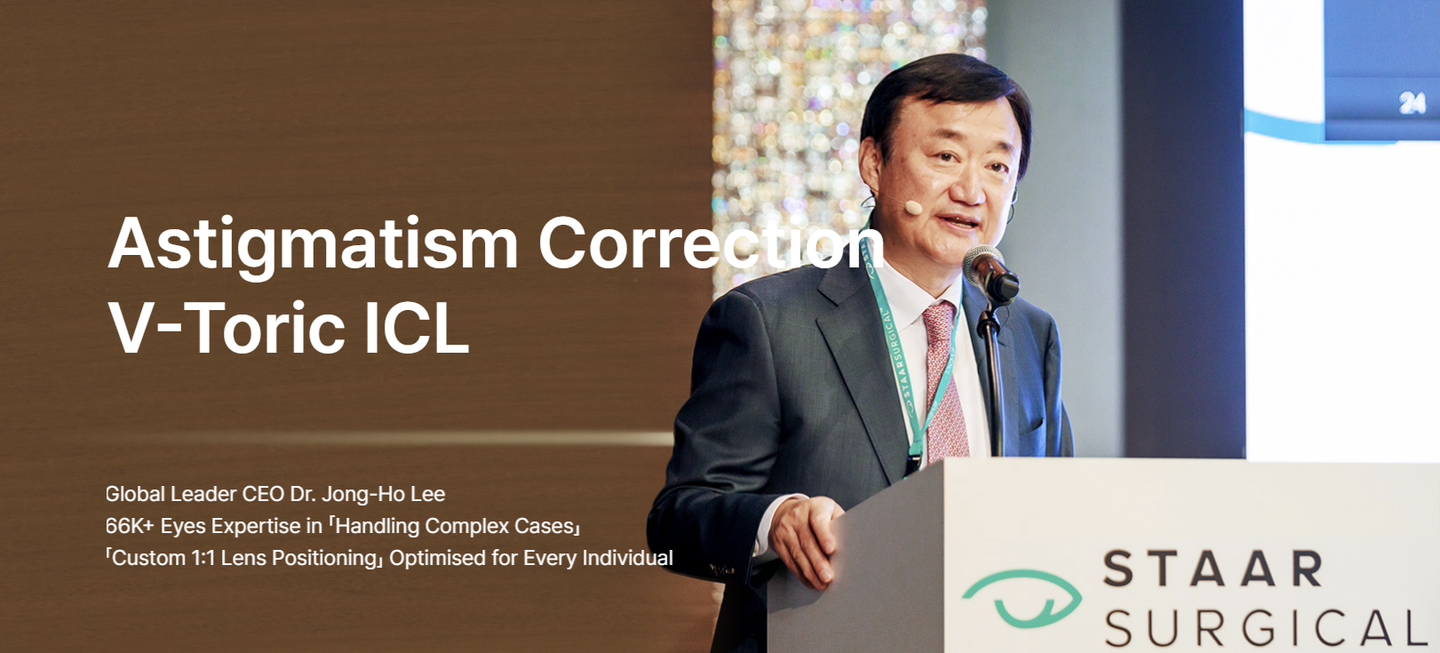
Dr. Jong-Ho Lee, M.D., Ph.D.
Dr. Lee is a pioneer of first-generation LASIK, LASEK and ICL in Korea and is known internationally for complex-case ICL and custom lens positioning for astigmatism. He reviews the medical content on this website.
Editorial policy: clinical statements on this page are checked against the sources below and BGSS outcome data, and are reviewed at least once a year. Prices are the clinic's published 2026 rates.
How surgery in Korea works, step by step
Most international patients plan a stay of about one week. Your coordinator confirms the exact timeline after reviewing your records.
Send your details
WhatsApp, LINE, WeChat or KakaoTalk your prescription and preferred dates. Free, with no obligation.
Get a personal plan
Receive a likely procedure, an estimated cost and a reserved exam slot.
Exam & surgery in Seoul
A 2–3 hour exam with your surgeon. If suitable, surgery can often be the same or next day.
Follow-up & fly home
Post-op checks before departure, then remote follow-up. Your surgeon confirms when it is safe to fly.
Frequently asked questions
Is refractive surgery the same as LASIK?
LASIK is one type. Refractive surgery also includes LASEK/PRK, SMILE Pro, phakic lenses such as ICL, and lens replacement.
Can refractive surgery fix presbyopia?
Laser for distance does not prevent presbyopia. Lens replacement with multifocal or EDOF lenses can reduce reading-glass dependence; no lens can guarantee full independence.
Which option has the fastest recovery?
LASIK typically gives functional vision the next day; ICL usually within 24 hours; SMILE Pro 1–2 days; LASEK/PRK 3–5 days.
Is there an upper age limit?
Not strictly. The choice shifts with age: older patients are more often guided toward lens surgery.
Can I combine procedures?
Sometimes, for example a lens procedure followed by a laser touch-up. Your surgeon will explain if this applies.
How do I find out which is right for me?
Send your prescription for a free pre-assessment; the final recommendation follows a 2–3 hour exam in Korea.
Ready to see clearly? Start with a free consultation.
Send your prescription today and get a personal treatment plan and price estimate within 24 hours.
- Free consultation
- No obligation
- Reply within 24 hours
- Korea's first JCI-accredited eye clinic
Medical information on this page is for general education and does not replace a consultation with an ophthalmologist. Results vary by individual, and suitability is determined after a full pre-operative eye examination. Statistics: BGSS Seoul + Busan cumulative totals as of December 2025.
Refractive Eye Surgery in Korea –
Seoul BGSS Eye Clinic
Advanced Laser Vision Correction in Gangnam, Seoul
Refractive eye surgery in Korea is recognized globally for its precision technology and structured diagnostic systems. Seoul BGSS Eye Clinic in Gangnam specializes in modern refractive procedures including SMILE Pro, Custom LASIK, Bladeless LASIK, LASEK, and ICL lens implantation, offering personalized surgical planning based on detailed ocular analysis.
What Is Refractive Eye Surgery?
Refractive surgery reshapes or corrects the eye’s focusing power to reduce dependency on glasses or contact lenses. It treats:
- Myopia (nearsightedness)
- Hyperopia (farsightedness)
- Astigmatism
- Presbyopia (age-related near vision changes, depending on method)
Procedures Available at Seoul BGSS Eye Clinic
✔ SMILE Pro (Minimally Invasive Laser)
- Small incision technique
- No corneal flap
- Reduced dry eye risk in appropriate candidates
- Fast recovery
✔ Custom / Wavefront LASIK
- Personalized mapping-based laser correction
- Addresses higher-order aberrations
- Optimized night vision clarity
✔ Bladeless LASIK (All-Laser LASIK)
- Femtosecond laser flap creation
- Precise and predictable outcomes
- Rapid visual recovery
✔ LASEK / Surface Laser
- Suitable for thinner corneas
- Longer recovery but excellent long-term stability
✔ ICL (Implantable Collamer Lens)
- Lens implanted inside the eye
- Option for high myopia or thin corneas
- Reversible procedure
Why Choose Seoul BGSS Eye Clinic in Gangnam?
🔬 Comprehensive Pre-Surgical
Diagnostics
- Corneal topography & tomography
- Pachymetry (corneal thickness measurement)
- Wavefront aberrometry
- Tear film and dry eye evaluation
- Retinal health examination
👨⚕️ Individualized Surgical Planning
Each treatment is selected based on corneal thickness, prescription strength, pupil size, and lifestyle needs.
🌎 International Patient Services
- English-speaking coordinators
- Efficient short-term surgery scheduling
- Structured post-operative follow-up guidance
Cost of Refractive Surgery in Korea (Estimated)
ProcedureApproximate Range (KRW)SMILE Pro₩2.5M – ₩3.8MLASIK₩1.8M – ₩3.0MLASEK₩1.5M – ₩2.5MICL₩4.5M – ₩7.0M
Final cost depends on eye condition, technology platform, and personalized surgical plan.
Recovery & Expectations
- Vision often improves within 24–48 hours (LASIK/SMILE)
- Temporary dryness or glare may occur
- Full stabilization varies by procedure
- Follow-up visits monitor healing and visual performance
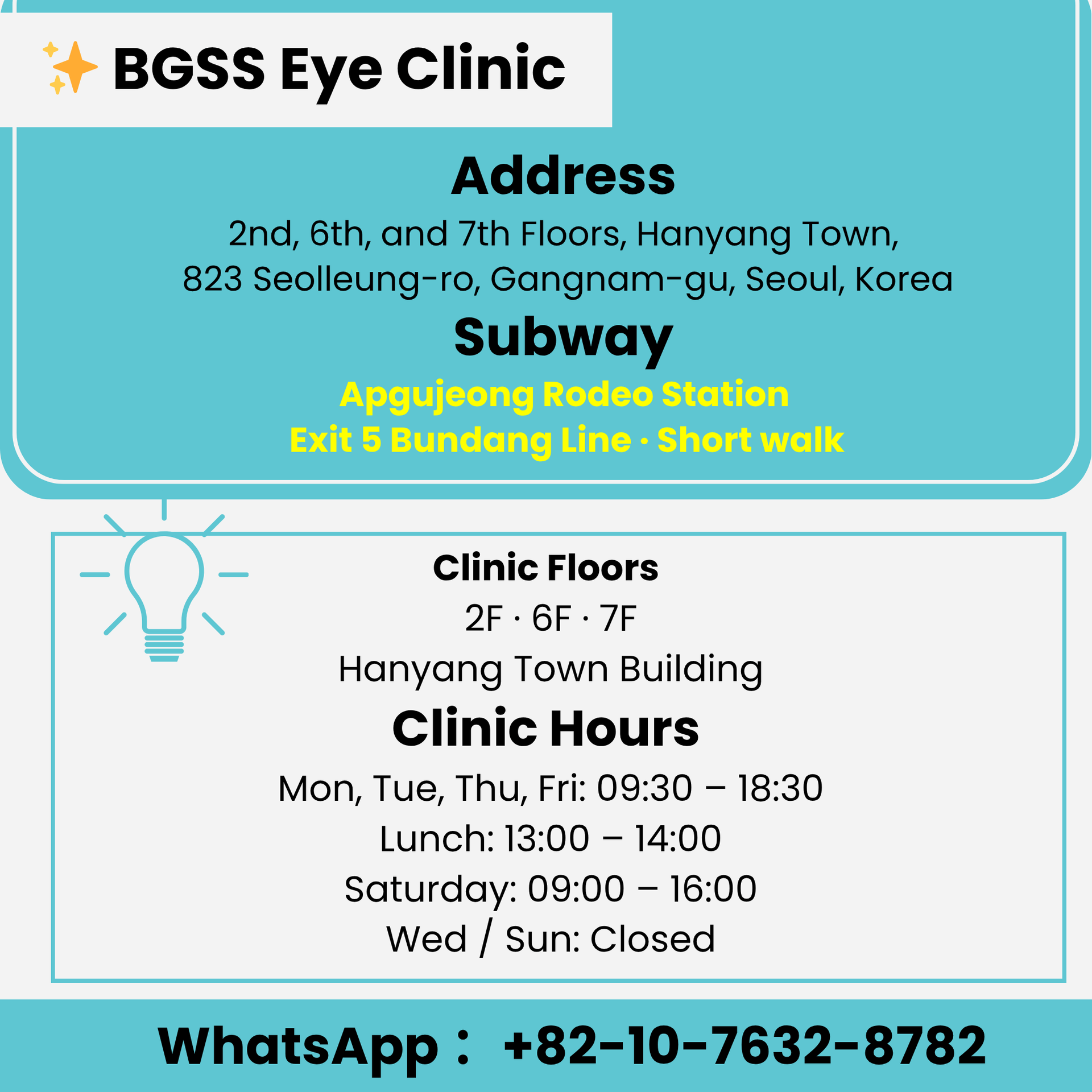
Location – Gangnam, Seoul
Seoul BGSS Eye Clinic is located in Gangnam, one of Korea’s leading medical districts for advanced ophthalmic surgery and refractive technology.